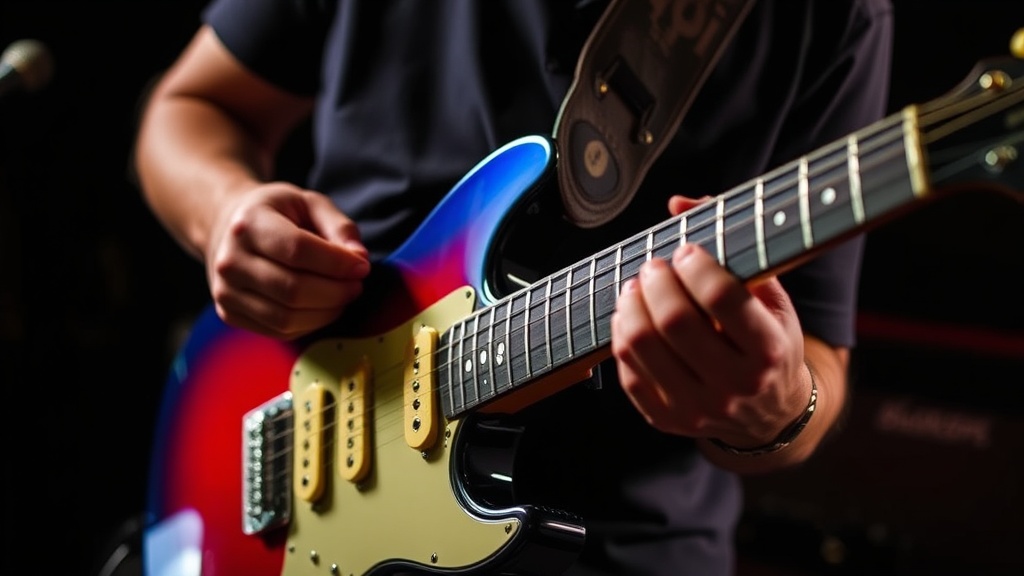
Why Your Pick Attack Is Killing Your Tone

Stop Blaming Your Gear for a Weak Sound
Most players think they need a $3,000 boutique overdrive pedal to get that aggressive, cutting edge during a rhythm section. They spend hours tweaking gain stages and looking for the perfect EQ curve, but they ignore the most fundamental variable in the signal chain: the way their pick actually hits the string. If your right hand is soft or your pick angle is inconsistent, no amount of high-end gear will save your sound. A weak attack results in a thin, polite tone that gets buried the moment the drummer hits the snare. You aren't just playing notes; you're hitting a physical object, and that impact dictates your dynamic range.
In my years playing clubs where the monitors were too loud and the room was too small, I learned that the difference between a pro session player and an amateur isn't how many pedals they own. It's how much authority they have over their pick stroke. A firm, controlled attack provides the percussive "thump" that makes a rhythm part feel heavy. If you're just grazing the string, you're losing the transient energy that makes a guitar cut through a mix. You need to treat the pick like a drumstick, not a feather.
Does Pick Thickness Change My Sound?
There is a massive debate in the gear world about whether a heavy pick or a light pick is "better." The truth is, it depends on the friction and the resistance you're looking for. A heavy, stiff pick—something around 1.5mm or 2.0mm—offers incredible control for downstrokes and rhythmic precision. It doesn't bend under pressure, meaning the energy from your wrist goes directly into the string. This is what you want for heavy riffing or metal-style alternate picking where you need a sharp, biting attack.
However, a thinner pick provides a certain "give" that can help with speed and certain jazzier, more fluid textures. If you're playing a song with fast, repetitive sixteenth notes, a slightly thinner pick might prevent your hand from fatiguing as quickly. But don't rely on that "give" to fix a bad technique. If your pick is too flimsy for the genre you're playing, you'll end up sounding mushy. For most rock and blues-based rhythm work, I suggest a medium-heavy pick (around 1.0mm) as a baseline. It gives you enough stiffness to drive the amp but enough flexibility to avoid sounding like a jackhammer every time you hit a mistake.
To understand how much physics is actually at play here, look at the way professional players approach the string. You can check out more about the physics of string vibration on sites like ScienceDirect if you want to get deep into the math of it, but for the practical player, it's about the angle of incidence. If you hold the pick flat against the string, you'll get a lot of resistance and potentially a "scratchy" sound. If you tilt the pick slightly (about 30 degrees), you'll find a sweet spot where the pick slides through the string, giving you a much cleaner, more consistent note production.
How Can I Improve My Rhythmic Precision?
If your playing feels "loose" or "sloppy," the problem usually isn't your timing—it's your physical connection to the instrument. To fix this, you need to focus on the weight of your strike. Are you hitting the string with your whole arm, or is the movement coming from the wrist? For rhythm playing, the wrist is your engine. A stiff arm creates a clunky, unmusical sound, while a limp wrist makes you sound weak. You want a controlled, springy tension in your wrist that allows for rapid-fire strokes without losing the intensity of the hit.
Try this exercise: set a metronome to a slow tempo, maybe 60 BPM, and focus entirely on the sound of the pick hitting the string. Don't worry about the actual notes for a second. Just focus on the *click* of the pick. Does it sound consistent? Is the volume of the strike the same on every beat? If your "click" is uneven, your rhythm will always be shaky. A great rhythm player's greatest tool is a consistent attack. If you can't hit the string with the same force ten times in a row, you aren't ready to play a professional gig.
Another way to develop this is by using different types of picks to find your "voice." I've seen guys go from a standard celluloid pick to a heavy Delrin pick and suddenly their rhythm parts sounded twice as thick. It's not magic; it's just more efficient energy transfer. You can see a variety of tool specifications and materials at retailers like Sweetwater to see how different thicknesses are categorized. It's a small change that yields massive results in your live tone.
The Role of Pick Orientation
Where you hold the pick matters just as much as what you're holding. If you're gripping it too close to the tip, you have more control but less "give." If you're holding it further back, it might feel more comfortable, but you'll lose that precision. Most of the guys I played with in the Midwest circuit would hold the pick with just the very tips of their fingers to ensure the most direct, authoritative strike possible. This prevents the pick from "wobbling" in your grip during heavy sections.
If you find your pick is constantly slipping out of your hand during a heavy riff, you're either not gripping it tight enough or you're using a pick that's too smooth for your sweaty hands. This isn't a gear failure; it's a mechanical one. Work on your grip tension. You want enough tension to keep the pick stable, but not so much that your hand cramps up after three songs. It's a balance of strength and relaxation that comes with thousands of hours of repetition.
Can Pick Attack Affect My Amp's Response?
Absolutely. An amp is a reactive instrument. If you hit the strings with a heavy, aggressive stroke, you're actually pushing the preamp harder. This is why a "heavy" player can make a clean amp sound much more aggressive than a "light" player. If you're playing through a tube amp, that extra kinetic energy from your pick strike is going to translate into more harmonic richness. It's not just about the volume; it's about the density of the sound.
When you're playing with a band, the drummer is your best friend or your worst enemy. If your pick attack is weak, you'll find yourself fighting the drummer to be heard. You'll try to turn up your volume, but you'll just end up sounding "thin" and "loud" instead of "heavy" and "present." A strong, percussive attack allows you to sit "inside" the drum groove rather than just playing on top of it. That's the difference between a guy who plays in a garage and a guy who can hold a stage in a professional setting.
- Heavy Pick: Best for precision, heavy riffing, and consistent low-end response.
- Medium Pick: Good for versatility, blending blues, rock, and some rhythmic funk.
- Light Pick: Best for speed-oriented strumming and acoustic-style textures.
Stop looking for the next pedal to fix your sound. Go back to the basics. Pick up a different gauge of pick, change your angle, and work on the physical way you strike the strings. Your tone is in your hands, not your pedalboard.