
How to Fix Your Sloppy Rhythm Guitar (The Right Hand Guide Nobody Teaches)

Alright, listen—if your playing sounds like a loose shopping cart rattling down a parking lot, it’s not your chords. It’s your right hand. Everyone wants faster fingers, cleaner solos, cooler gear… but the truth is ugly: your rhythm is the whole game.
I’ve watched players spend years memorizing scales and still sound like a mess in a band. Meanwhile, the guy who locks his strumming hand like a snare drum? He gets the gig.
This is the fix. No fluff, no "practice this for 3 hours." We’re dialing in your right hand so your playing actually feels like music.

Step 1: Lock Your Hand Into a Constant Motion
First thing—your strumming hand should never freeze. Ever.
Even when you’re not hitting the strings, your hand keeps moving like a pendulum. Down-up-down-up. Think of it like walking—you don’t stop mid-step because there’s a crack in the sidewalk.
Most beginners (and a lot of intermediates) do this: they stop the hand, aim for the string, then hit it. That’s why everything feels stiff.
The fix: keep your hand moving and just "miss" the strings when you don’t need to hit them.
The Secret Sauce
The groove lives in the motion, not the contact. You’re not aiming—you’re flowing through.

Step 2: Build the "Click" (Your Internal Snare Drum)
Real talk—great rhythm players sound like a drummer with strings attached.
You need a built-in "click" on your downstrokes. That little snap when the pick hits the strings? That’s your snare.
Try this:
- Mute the strings with your left hand
- Strum 8th notes (down-up-down-up)
- Accentuate the downstrokes like you’re hitting a snare drum
If it doesn’t make you nod your head, it’s not working yet.
The Knuckle-Buster
Keep it consistent for a full minute. No speeding up, no slowing down. Most people fall apart after 20 seconds—that’s where the real work starts.

Step 3: Control Your Dynamics (Stop Playing Everything the Same)
Here’s another thing killing your sound: everything you play is the same volume.
Music breathes. Some strokes hit harder, some barely whisper.
Try this pattern:
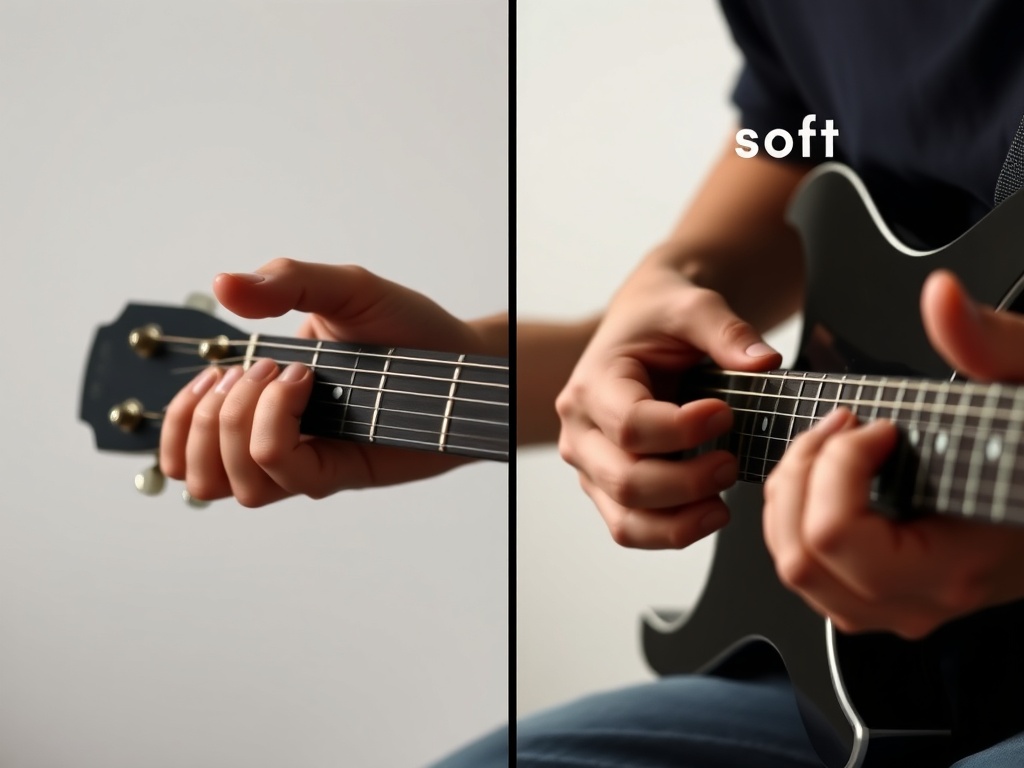
- Down (hard)
- Up (soft)
- Down (medium)
- Up (ghost—barely touch it)
Now loop that. Suddenly, it starts sounding like a groove instead of a robot.
The Secret Sauce
The "ghost strum" is where the feel lives. That almost-silent upstroke keeps the rhythm glued together.
Step 4: Sync With Your Left Hand (No More Flam Notes)
If your chords sound sloppy, it’s probably not your fretting—it’s your timing.
Your right hand and left hand need to land at the exact same time. If your right hand hits before the chord is ready, you get that ugly "flam" sound.
Fix it like this:
- Practice switching between two chords slowly
- Only strum when both hands are perfectly in place
- If it buzzes or clunks, reset and try again
Yeah, it’s boring. Do it anyway. This is where bands get tight.

Step 5: Play Along With Real Songs (Not a Metronome Forever)
Metronomes are fine. Songs are better.
Put on a track you like—something simple. Think Tom Petty, Green Day, anything with a steady groove.
Your job isn’t to "play the chords." Your job is to disappear into the rhythm section.
If you can’t tell whether it’s you or the record playing, you’re getting close.
The Secret Sauce
Lock onto the hi-hat or snare. Ignore everything else. That’s your anchor.

Step 6: The 10-Minute Fix Routine
You don’t need an hour. You need consistency.
Here’s the routine I give guys before a gig:
- 2 minutes: Air strumming (no strings)
- 3 minutes: Muted strumming with accents
- 3 minutes: Chord switching slow and clean
- 2 minutes: Play along with a song
That’s it. Do it daily for a week and your playing will feel tighter than anything you’ve tried before.
Common Mistakes (Yeah, You’re Probably Doing These)
- Death grip on the pick: Relax. Let it flex.
- All downstrokes: You’re making life harder than it needs to be.
- Watching your left hand constantly: Your rhythm falls apart when your focus drifts.
- Ignoring feel: If it doesn’t make your head move, it’s not right yet.
Final Word
Look—nobody in a bar has ever said, "Wow, that guy knew a lot of scales."
They feel the groove. Or they don’t.
Get your right hand together and suddenly everything else—your chords, your riffs, even your solos—start sounding better without you touching them.
That’s the whole trick.
Now go make some noise.
Steps
- 1
Lock Your Hand Into a Constant Motion
- 2
Build the Internal Click
- 3
Control Your Dynamics
- 4
Sync Both Hands
- 5
Play Along With Songs
- 6
Follow a 10-Minute Routine